 Universe Today

For astronomers and cosmologists, the Cosmic Dark Ages are the final frontier, holding the answers to how the first stars and galaxies formed and evolved. According to the most widely held theories, the first generation of stars formed about 100 to 400 million years after the Big Bang. Even with the powerful optics of Hubble and the James Webb Space Telescope, scientists still cannot resolve these ancient stars when looking at the early Universe and its infant galaxies.
Luckily, an international team of researchers has done the next best thing using the MEGATRON project. Using this advanced cosmological simulation suite, along with sophisticated models of radiation, chemistry, and galaxy formation, the team created the most detailed simulations of the early Universe to date. The results show the connection between observations of the early Universe and the chemical fingerprint of the oldest stars in the Milky Way.
The study was led by researchers from the University of Bath, the Kavli Institute for Cosmological Physics, the Institut d’Astrophysique de Paris, the Lund Observatory, the Cambridge Kavli Institute for Cosmology, the Cavendish Laboratory, the Kavli Institute for Particle Astrophysics & Cosmology (KIPAC), the Sterrenkundig Observatorium, the Laboratoire d’Astrophysique, and the Ecole Polytechnique Federale de Lausanne (EPFL). Their findings were presented in four papers published in the Open Journal of Astrophysics.
 The center of the Milky Way as seen from Chile. The core contains very old stars that date back to early in cosmic history. Credit: ESO/P.Horalek CC by 4.0.
The MEGATRON project began in 2023 and is scheduled to run until 2030. Using this suite, the team investigated how stars shape the gas in the interstellar and intergalactic medium (ISM and GSM) over billions of years. They included advanced computer models that tracked gas movement, starlight propagation, and the evolution of chemical concentrations. This allowed them to track the evolution of a young galaxy that eventually grew to a mass similar to the Milky Way.
As Dr. Martin Rey from the Department of Physics at the University of Bath and a lead contributor to the MEGATRON collaboration described:
MEGATRON provides a common physical framework for interpreting two of astronomy's most exciting new datasets: JWST's view of the earliest galaxies and the stellar fossil record. Together, these complementary observations allow us to test competing models of the first stars in ways that weren't previously possible.
The simulations began with conditions present shortly after the Big Bang, when the Universe was permeated by pristine gas with no heavy elements. They then included the birth of the first stars (Population III), the intense radiation they emitted, and their fiery supernovae, which seeded the ISM and GSM with newly formed heavy elements. Finally, the simulations tracked how these new elements would become part of the next generations of stars and galaxies.
"The James Webb Space Telescope gives us a direct glimpse of the infant cosmos, while stellar archaeology allows us to study the relics of those earliest times in our own Galactic neighborhood," Said Dr. Rey. "MEGATRON provides a physical bridge between the two."
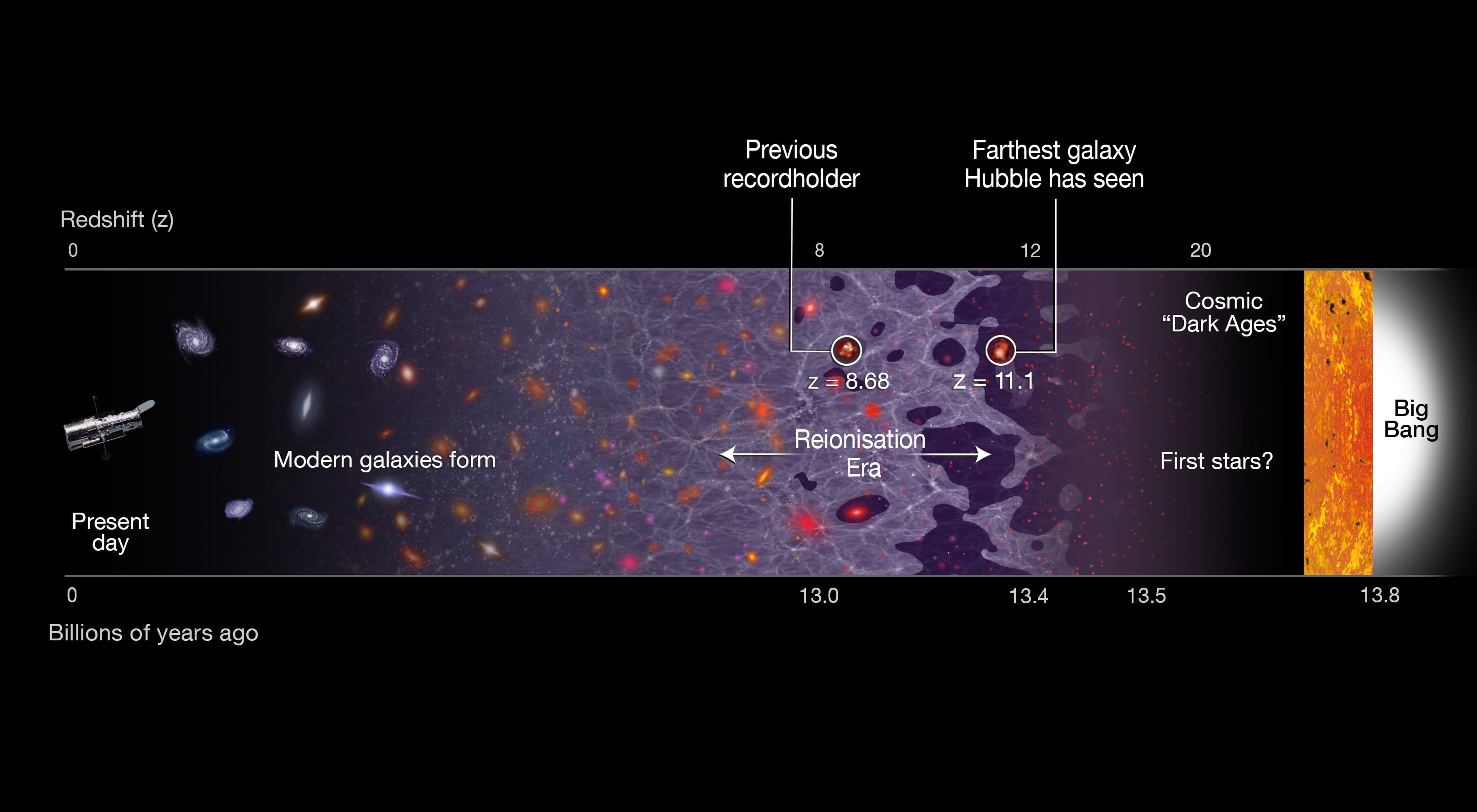 An illustration showing the timeline of the Universe. The EOR ended the Cosmic Dark Ages and began about 400 million years after the Big Bang. Credit: NASA, ESA, and A. Feild (STScI)
The results show that accurately capturing the interplay between starlight, gas, and newly forged elements is essential to connecting Webb's groundbreaking observations of young galaxies with the chemical makeup preserved in ancient stars. Understanding this process is central to addressing the fundamental question of where the elements that make up the Universe originated.
The results also suggest that previous simpler models of galactic evolution underestimated how gas in the IGM was influenced by stellar radiation and complex chemical processes. Thanks to the exceptionally high resolution the team achieved, they were able to resolve gas structures that simpler models cannot. What the team achieved with MEGATRON will help astronomers improve their predictions for current and future observations. Said Dr. Rey:
The elements that make our world and life possible – carbon, oxygen, iron and many others – were forged by stars. To understand where those elements came from, we need to understand how the first stars formed and enriched their surroundings. MEGATRON allows us to test these ideas directly by comparing detailed simulations with observations from JWST and the chemical fingerprints preserved in ancient stars.
Looking ahead, Dr. Rey and his colleagues at Bath are already developing the next generation of simulations. Their ultimate goal is to use MEGATRON simulations to strengthen links between theory and Webb's ongoing observations of the early Universe. The project was recently awarded 40 million processor hours on the UK's national supercomputers, enabling higher-resolution simulations with more complete physical models. Said Dr Rey:
MEGATRON provides a common physical framework for interpreting two of astronomy's most exciting new datasets: JWST's view of the earliest galaxies and the stellar fossil record. Together, these complementary observations allow us to test competing models of the first stars in ways that weren't previously possible.
Further Reading: University of Bath

