 Universe Today
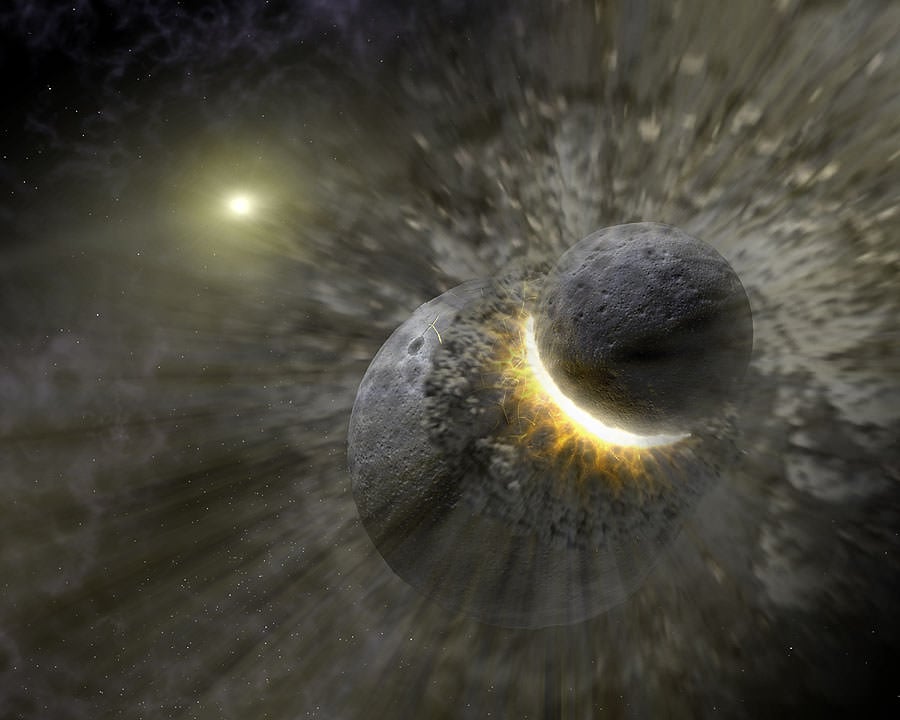
The Giant Impact Hypothesis says that about 4.5 billion years ago, a Mars-sized world named Theia slammed into the young Earth. The cataclysmic impact sent debris into a torus orbiting Earth, and out of that material the Moon formed. The hypothesis is widely-accepted, though unanswered questions remain.
Scientists use models and simulations based on ever-increasing detail to try to understand how the Moon formed from this collision. New research in The Astrophysical Journal Letters used models to understand how temperature and material strength affected the Moon's formation. It's titled "Collisional Capture of an Intact Moon Depends on Strength," and the lead author is Dr. Adeene Denton, a postdoctoral researcher in the Southwest Research Institute’s Solar System Science and Exploration Division.
"The canonical giant impact hypothesis suggests that the proto-Earth’s collision with a differentiated Mars-sized planet, Theia, produced an iron-poor debris disk that accreted to form the Moon," the authors write. "Here, we revisit that hypothesis, for the first time using smoothed-particle hydrodynamics (SPH) simulations with realistic strength."
Previous research into the GIH using models and simulations ignored the strength of the materials involved in the impact. The thinking was that in a collision this energetic, that strength wouldn't have any appreciable effect on the outcome. In this work, Denton and her co-researchers took another look at the GIH and this time they incorporated temperature-dependent material strength into their models.
“Models have evolved to include material strength, something that’s really important when you’re studying collisions between smaller bodies like asteroids or for my previous paper about the formation of the Pluto-Charon system,” lead author Denton said in a press release. “We weren’t sure if it would matter for the Moon or not. When we did the simulations, we found it actually matters quite a bit.”
Hotter material is weaker than colder material, so hotter bodies are weaker than cooler ones. The team's simulations showed that this matters in the formation of the Moon. "Although negligible compared to stresses in the deep interior, strength in the outer hundreds of kilometers of Theia is shown to hinder its deformation, which alters the transfer of momentum, leading to fundamental differences in Moon formation," the researchers explain in their work.
This is significant because rocky protoplanets cool over time. They're hot when they form and then gradually cool down. The temperature of the proto-Earth and Theia dictates the outcome of the collision and how the Moon formed.
"For one set of otherwise identical canonical impact parameters, a hot but solid Theia produces an intact Moon, whereas a colder, stronger Theia—i.e., a later Moon-formation scenario—produces a classic protolunar disk," the authors write.
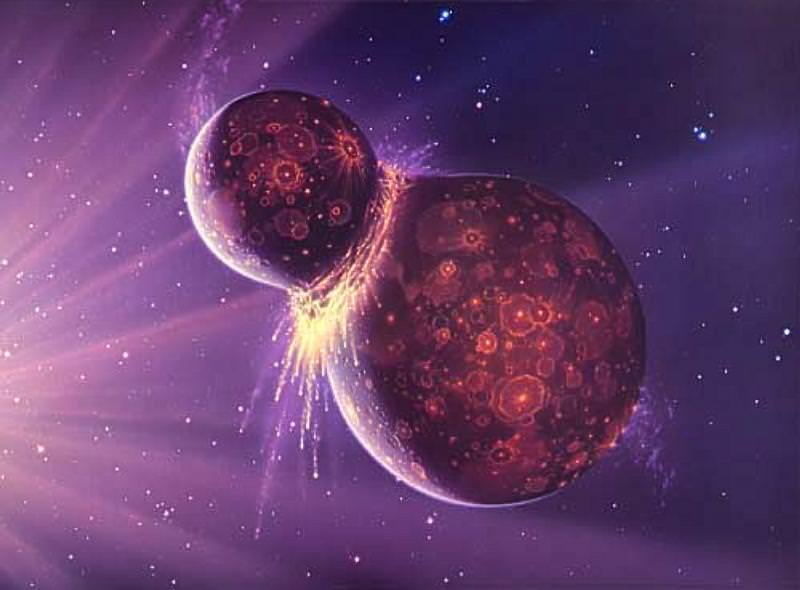 Artist's impression of the impact that caused the formation of the Moon. New research highlights the role of temperature and material strength in the outcome. Credit: NASA/GSFC
A classic protolunar disk is the the result of initial modelling of the GIH. In it, the disk forms out of material that's mostly from Theia's mantle, with comparatively little material from Earth joining the disk. In this scenario, the disk is not fully vapourized. The outer region of the disk is cooler, and this is where the Moon mainly forms. But this classic model also says that the Moon's composition should be distinct from Earth's, and isotopic studies show that they're close to identical.
"These completely different scenarios arise from different mechanical responses due to temperature and establish an important new connection between giant impact dynamics and the timing and geochemistry of lunar formation," the researchers write. The timing varies quite a bit, with the Moon forming in only a few hours in one scenario. "The inclusion of strength (resistance to shear in solid materials) is demonstrated to have a profound influence on whether the Moon forms relatively intact or accretes from a debris disk in orbit around the Earth." the authors explain.
“Depending on how hot the Earth and Theia are prior to the collision, the impact can destroy Theia and produce this massive disk of debris that eventually forms the Moon,” Denton said. “But when I used the same parameters as original impact modeling — down to the equal temperature structures inside both bodies — within around five hours, an intact Moon emerged.”
When the collision is hot and material is weaker, Earth accretes about 91% of Theia, and a melt-dominated debris disk. The researchers say this result is in line with previous models. But when the collision is cool, and when the material is stronger as a result, some of Theia survives as an intact, captured satellite in orbit around Earth.
 These panels show the final state of two identical Moon-forming simulations. The top one shows the results when material strength isn't included. The bottom one includes material strength. "The fluid collision (top) results in the accretion of 91% of Theia and production of a debris disk, nothing larger than 2% of Theia, consistent with prior studies," the authors write. "The collision with strength (bottom) accretes less of Theia directly (84%) and, in this case, captures an intact Moon mass remnant into orbit." Image Credit: Denton et al. 2026. ApJL
The nature of the GIH and the Moon's formation has been studied intensely, and plenty of other researchers have used simulations to gain insight. Many simulations have resulted in intact Moons, rather than in Moons that take longer to form in disks. But, according to the researchers, this is the first time that the temperature and strength of the materials involved play a role.
“These surprising and exciting new results imply a potential connection between the physical properties of the Moon today, including perhaps its volatile content, and the thermal state of the Earth and Theia at the time of the giant impact,” said Dr. Robin Canup, vice president of SwRI’s Solar System Science and Exploration Division. Canup was not involved in the study but has published earlier research about the GIH. “This in turn might help scientists better constrain when the Moon-forming event occurred.”
These simulations still leave something unexplained, though. The isotopic composition of Earth and the Moon are nearly identical, but their bulk compositions are different in significant ways. The Moon is depleted of volatiles, has only a tiny iron core—possibly none at all—and its mantle is enriched in refractory elements.
One of the main strengths of the GIH is that it explains the identical isotopic composition of both bodies. That can be explained if both bodies formed in the same region of the protoplanetary disk around the young Sun. But clearly, there's still work to do to understand the history of both the Earth and the Moon.
"The broader implication of this work is to establish a novel connection between the giant impact dynamics of Moon formation and Theia’s strength as a function of temperature, potentially connecting the initial state of the Moon—formed intact or from a debris disk—to the timing of the collision between Theia and the proto-Earth," the authors conclude.

