 Universe Today

The Universe has been making fewer stars lately, and astronomers want to know why. The obvious answer is: there hasn't been enough star-birth material. Is that true? If so, what other process is at play that's slowing it down? An international team led by researcher Hong Guo of the Chinese Academy of Sciences decided to dig into the reasons why it looks like starbirth is falling off.
The team used the Five-hundred-meter Aperture Spherical radio Telescope (FAST) to make high-precision measurements of cosmic neutral hydrogen (HI) over the past 4.5 billion years. It's an important source for galaxies and is detected through 21-centimeter radio emissions. The collaboration also included observations made using the Dark Energy Spectroscopic Instrument (DESI) project. The study looked at a sample of about 2.5 million galaxies, covering nearly a third of the sky. The result is that 4.5 billion years ago, the star formation rate across the Universe was about 2.5 times higher than today. At the same time, the neutral atomic hydrogen density was about 1.4 times its current level. This is odd, because it doesn't explain the current decline in star formation, according to Hong, who said that what they found is not what they expected.
"What we find is that during the most recent 4.5 billion years, star formation continued to decline substantially, while the cosmic reservoir of neutral atomic hydrogen changed surprisingly little," he said, pointing out that the study only reached back through that time period. "We are not studying the full history of the decline in cosmic star formation, but rather its late-time phase. The cosmic star-formation rate reached its maximum much earlier, around z~2, roughly 10 billion years ago, during what astronomers sometimes call “cosmic noon.” It has been declining since then. The amount of neutral atomic hydrogen changes only weakly, even though the rate at which new stars are being formed changes much more strongly."
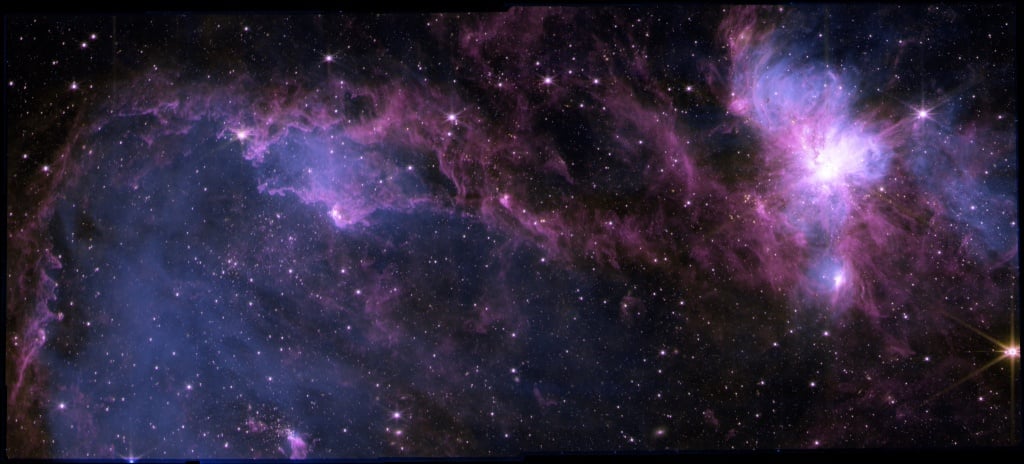 A composite image created using JWST NIRCam and ALMA data. Light from stars is shown in yellow, while blue and purple represent the dust and gas fueling star formation. Such clouds rely on the cycling of neutral hydrogen to supply hydrogen gas. Image Credit: NSF/AUI/NSF NRAO/S.Dagnello
Tracking the Decline
To understand the finding, it's important to look at the fuel sources for star birth. Astronomers know that star formation relies on the existence of cold clouds of hydrogen gas (H2). It's logical to assume that as stars form in the Universe, H2 gets consumed, and that should lead to a sharp drop in star formation in more modern epochs of cosmic history. However, that's not what's happened.
To get H2, you need HI, which links the larger-scale cosmic gas cycle to star formation in galaxies. This neutral hydrogen reservoir is a link between the larger gas supply and the formation of the molecular gas (H2) needed for star formation. The study seems to imply that the changes seen in the past 4.5 billion years may not be occurring in the reservoir of HI. Rather, it happens in what's called the "baryon cycle". That's the process by which normal matter (referred to as baryonic matter) is exchanged between galaxies and the intergalactic environment. The cycle includes the processes that occur when matter gets pulled into a galaxy, and when it gets expelled back to the intergalactic environment.
In this case, as the gas supply from the larger cosmic web declines and weakens, it affects the efficiency of converting neutral hydrogen into H2. The overall neutral hydrogen supply remains stable, but the molecular gas gradually disappears and isn't replenished. That affects the rate of star formation, which explains the drop-off seen in the more modern epochs of cosmic history.
Future Directions
While knowing the total amount of hydrogen in the Universe is important, this study gives new insight into the conditions that affect star birth. The FAST-DESI study is only one benchmark for understanding why star formation declined more recently, but it also has implications for the study of galaxy evolution. The FAST can only reach back to about 7.2 billion years, so future studies should look at conditions in the Universe before that time. In particular, future observations should include deeper surveys across a wide variety of wavelengths and frequencies to tap into the signals from earlier epochs of time.
For More Information
Study: Declining Star Formation Not Caused by Simple "Fuel Crisis"
Weak Evolution of Cosmic Atomic Hydrogen Over the Past 4.5 Billion Years

