 Universe Today

Massive galaxies like the Milky Way have a retinue of smaller, dim satellites on their outskirts. They're hard to detect, and while astronomers have found about 65 of the Milky Way's dwarf satellite galaxies, and about 40 globular clusters in its halo, they suspect there are many dwarf satellites and globular clusters yet to be found. Now the Vera Rubin Observatory has found two more.
The Milky Way's satellites are either small dim galaxies or globular clusters, and both are part of the assembly history of the Milky Way through mergers. These two detections by the Rubin, found in its Early Data Preview 2 (EDP2) released in July 2026, are almost certainly the beginning of many more discoveries of Milky Way satellites by the powerful observatory. One is a most likely a dim dwarf galaxy named Aquarius IV, and one is a globular cluster named Rubin-GC1.
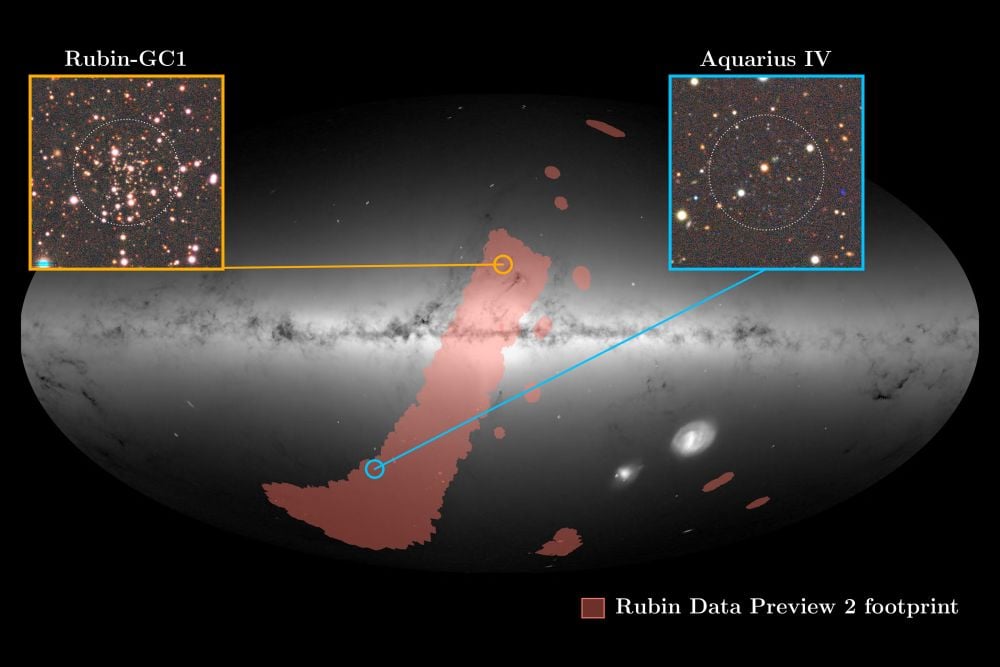 This figure shows the locations of both Rubin-GC1 and Aquarius IV. Rubin-GC1's detection was particularly impressive, since it's in the direction of the Milky Way's bulge, a region with a dense stellar population and thick dust. Image Credit: NSF-DOE Vera C. Rubin Observatory/NOIRLab/SLAC/AURA, ESA/Gaia/DPAC, W. Cerny
The discoveries are presented in two new papers.
One is titled "Discovery of the Distant, Ultra-faint Milky Way Satellite Aquarius IV with the Vera C. Rubin Observatory Early Data Preview 2." It's published in Research Notes of the American Astronomical Society, and the lead author is William Cerny, an astronomy student in Yale’s Graduate School of Arts and Sciences.
"We present the discovery of Aquarius IV (Rubin J2201−0234)—the first ultra-faint Milky Way (MW) satellite to be identified using data from the Vera C. Rubin Observatory," the authors write. It was confirmed in images from the Dark Energy Camera. The authors say it's a low-luminosity, compact stellar system in the outer Galactic halo.
It's stellar population is ancient and low-metallicity. "These properties closely resemble those of the smallest and faintest confirmed ultra-faint dwarf galaxies (UFDs), though a globular cluster classification is not ruled out," the researchers write.
Ultra-faint dwarf galaxies can have as little as a few hundred stars, which makes them smaller than some globular clusters (GCs). But there's one critical difference between UFDs and GCs: UFDs have dark matter while GCs don't (except for a few possible outliers).
Only a small number of the stars in Aquarius IV have been detected so far, so whether or not it is a UFD for sure will depend on deeper imaging and spectroscopy.
“What I find especially exciting is that these discoveries are just the beginning for Rubin,” said first author Cerny. (He is also the second author of the Rubin-GC1 study, which has been accepted by The Astrophysical Journal Letters.)
“If the observatory can find systems this faint and difficult with only its preview data, its full 10-year survey will undoubtedly provide us with many more Milky Way satellite discoveries,” Cerny said. “These new satellites will give us new opportunities to test models of galaxy formation, trace the assembly history of the Milky Way, and investigate the nature of dark matter.”
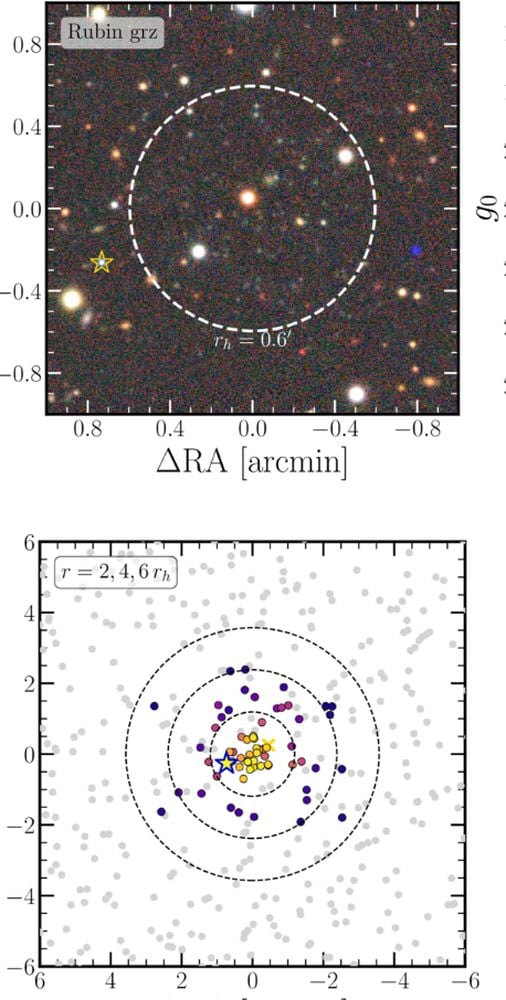 These panels are images centered on Aquarius IV. The star in the lower panel marks a Blue Horizontal Branch star used to determine the distance to Aquarius IV. The stars in the bottom panel are also coloured according to their probability of being members of Aquarius IV. The grey stars are almost certainly not members, while colours ranging from purple through red, orange, and yellow represent increasing probability. Image Credit: William Cerny et al 2026 Res. Notes AAS 10 239
The second paper is "Rubin Observatory Reveals a Dust-Shrouded Halo Globular Cluster in Ophiuchus," and it will be published in The Astrophysical Journal Letters. It's currently available at arxiv.org and the lead author is Aashay Pai. Pai is a graduate student in the Department of Physics at the University of Chicago.
"We present the discovery of the Milky Way satellite Rubin-GC1 (Rubin J1628−1735) using data from the NSF-DOE Vera C. Rubin Observatory’s Early Data Preview 2," the authors write. The stars in Rubin-GC1 have an intermediate age of about 9.2 billion years, and are moderately rich in metals, meaning it's most likely a very faint GC. "Together, these properties suggest Rubin-GC1 is most likely a star cluster in the faint tail of the luminosity function of globular clusters surrounding the Milky Way," the authors write.
Based on comparisons to the Sagittarius dwarf spheroidal galaxy, Rubin-GC1 is most likely a cluster accreted to the Milky Way, associated with the Sagittarius leading arm. The Sagittarius leading arm is a massive tidal stream of stars from the Sagittarius Dwarf Spheroidal Galaxy, torn away as that galaxy merges with the Milky Way.
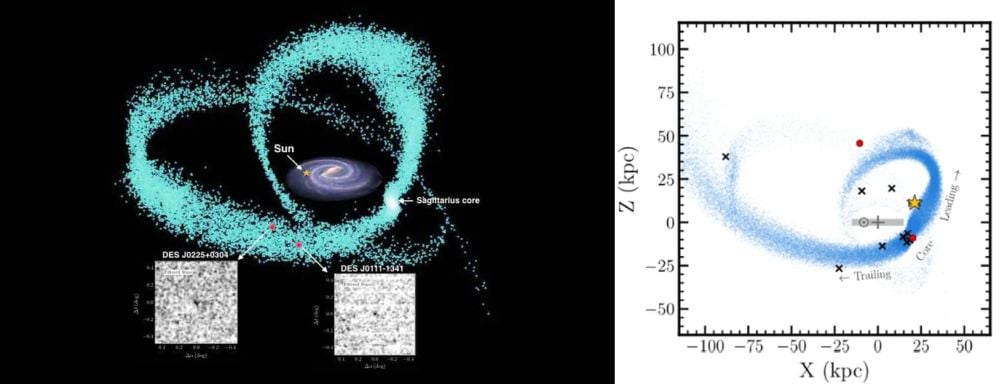 The panel on the left shows the Sagittarius trailing and leading arms. (The DES images are not part of this work.) The image on the right shows roughly where Rubin-GC1 is located, shown with the gold star. The Milky Way's center is shown with the black cross, and the circle with the dot inside is the Sun. Image Credit: Left: By NOIRLab, CC BY 4.0, https://commons.wikimedia.org/w/index.php?curid=139367207. Right: Aashay Pai et al. 2026.
“Finding new Milky Way satellites in Rubin Observatory data has been an exciting future prospect for most of my career,” said Marla Geha, a professor of astronomy and physics in Yale’s Faculty of Arts and Sciences, and co-author on both studies. “It is remarkable this is now a reality.”
Rubin-GC1 was detected in the direction of the galactic bulge, where stellar density is very high and the dust is thick. Finding it in those conditions makes the detection even more impressive. "The discovery of Rubin-GC1 highlights the potential of Rubin to uncover faint, resolved satellites in dust-shrouded regions of the Milky Way, including remnants of the accretion events that have shaped the Galaxy’s hierarchical assembly," the authors write.
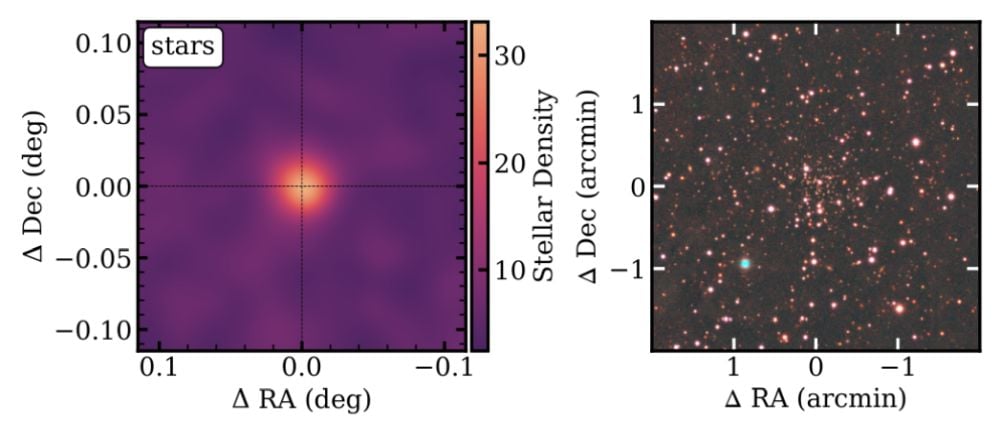 The panel on the left is what's called a 'smoothed isochrone filtered stellar density map.' It's a visualization tool in astronomy used to detect and map faint structures like ultra-faint dwarf galaxies by masking out field stars based on a color-magnitude curve. The panel on the right is a more familiar type of image used to show the region itself. Image Credit: Aashay Pai et al. 2026.
“These discoveries are incredibly promising,” Geha said. “Continued discoveries will allow us to complete the census of satellite galaxies around the Milky Way, which is a key to understanding how the faintest galaxies form.”
The Vera Rubin Observatory is mostly known as a transient-detecting observatory, and as the maker of a ten-year long movie of the sky in its Legacy Survey of Space and Time. But it's more than that. As it images the sky repeatedly, dim objects will become clearer. "The sensitivity of Rubin LSST will steadily increase, and systems similar to Aquarius IV are ultimately expected to be detectable with >85% efficiency using the same search algorithm applied here," the authors of the first paper write.
Not only that, but its observations will work with observations from other observatories, like the Nancy Grace Roman Space Telescope, to detect even more objects. "The identification of Rubin-GC1 heralds an exciting era of discovery as Rubin, Euclid, and the Nancy Grace Roman Space Telescope pierce the shroud of Galactic dust to reveal faint satellites that were hitherto hidden by our Galaxy," the authors of the second paper write.
Ultra-faint dwarf galaxies and globular clusters are puzzle pieces in the history of the Milky Way's growth through mergers. The mergers are ongoing, as interactions between the Magellanic Clouds and the Milky Way show.
By finding more of the Milky Way satellites, a picture of all of these mergers, and the role dark matter plays, will become clearer. By mapping out these objects and the streams they're sometimes a part of, astronomers can detect where dark matter also concentrates in clumps. These dark matter sub-halos will show how our galaxy grew larger by consuming smaller galaxies with their own dark matter halos.
