It's nearly impossible to identify individual stars billions of light years away. But thanks to gravitational lensing, astronomers have identified red giant stars in a distant galaxy.
Continue reading

Since the first fast radio burst (FRB) was discovered in 2007, astronomers have been puzzling over their source. These bright radio flashes come from seemingly random directions across the universe. Finally, astronomers have pinned down one FRB to a specific neutron star in a galaxy about 200 light-years away. The FRB was unleashed from a region within 10,000 km of the neutron star and probably emerged from its magnetosphere.
Continue reading
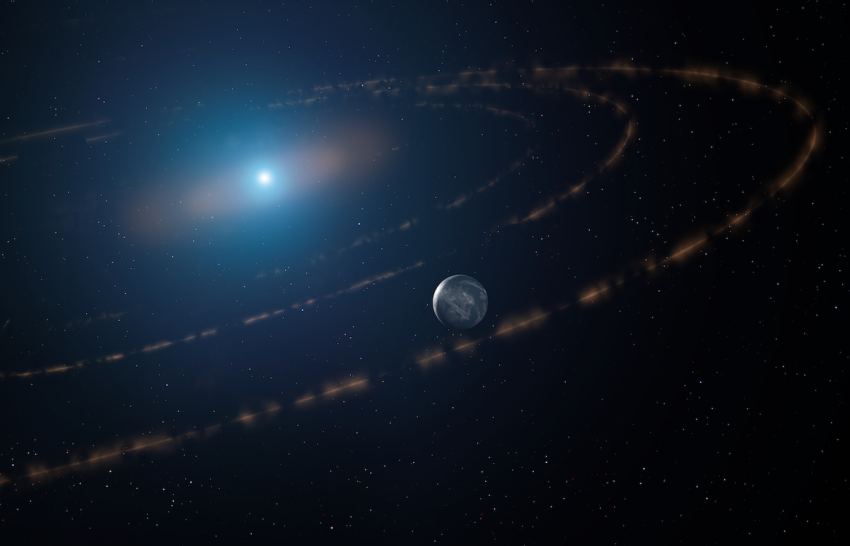
Some white dwarfs have planets, but to be habitable worlds they would need to hold on to their oceans during the star's red giant stage.
Continue reading

Trans-Neptunian Objects are the icy remnants of our early solar system. Part of their history can be found in the spectra of molecules and dust on their frozen surfaces.
Continue reading

Dark energy is central to the standard model of cosmology, but the Timescape model suggests dark matter doesn't exist.
Continue reading

Theoretically a neutron star could have less mass than a white dwarf. If these light neutron stars exist, we might detect them through the gravitational waves they emit during a cataclysmic merger with another star.
Continue reading

A current mystery in astronomy is how supermassive black holes gained so much heft so early in the Universe. Black holes have been seen in the first billion years after the Big Bang with hundreds of millions of solar masses, defying current models of their growth. Now, astronomers have a clue. They observed a bright jet coming from a type of supermassive black hole called a blazar, which interacts with surrounding gas, helping to drive it into the maw of the black hole.
Continue reading
 Universe Today