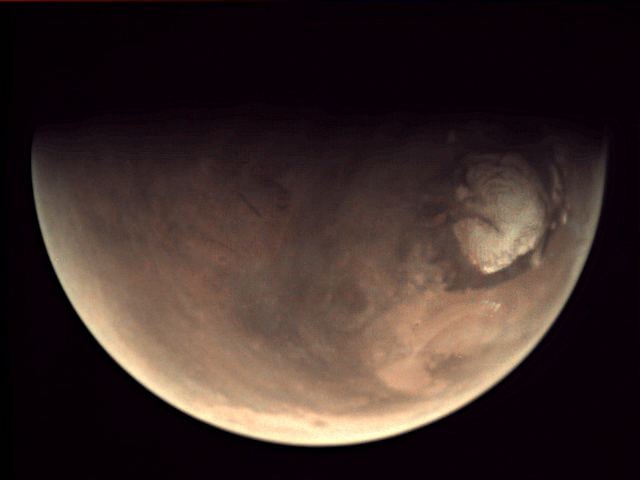
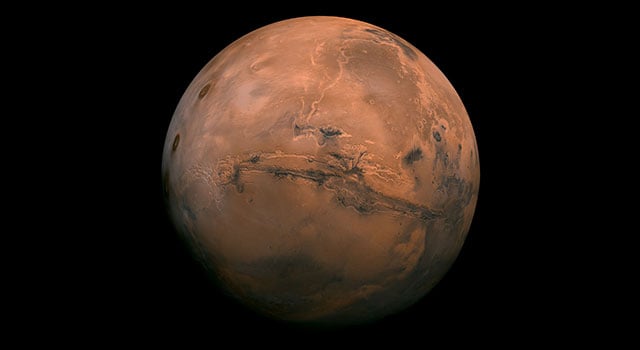
One mystery in planetary science is a satisfying origin story for Mars's moons, Phobos and Deimos. Were they chunks of Mars blasted into space by a meteor impact? Were they captured asteroids from the belt? A new supercomputer simulation found that a reasonable explanation could come from a massive asteroid passing just close enough to Mars that it was torn into pieces. Over time, chunks and debris would have settled into a disk around Mars and clumped into moons.
Continue reading

The Large Magellanic Cloud is the closest, brightest dwarf galaxy to the Milky Way—20 times bigger than the full Moon in the sky. Astronomers think that the LMC just completed its closest approach to the Milky Way, blowing away the spherical halo of gas surrounding it. Smaller galaxies would have shut down star formation, but the LMC has enough material to keep forming stars. New observations from Hubble have helped astronomers measure its halo structure.
Continue reading

One explanation for dark matter is that it's made out of primordial black holes, formed in the earliest moments of the universe. Although they've never been seen directly, asteroid-mass black holes could account for all the dark matter influence. It's believed that these low-mass black holes would be undetectable as they merged, releasing gravitational waves. But according to a new paper, if the conditions are ideal, there are instruments that might detect these mergers.
Continue reading

Although the outer Solar System is mostly empty, there are icy objects drifting within the very limits of detection by our largest telescopes. But maybe small telescopes can be more successful. A new paper suggests that an array of 200 automated 40-cm telescopes spread across 1,000 km could be the best way to find them. They would watch for changes in brightness as objects pass in front of stars and could even find the hypothetical Planet Nine.
Continue reading

About 370,000 years after the Big Bang, the Universe had cooled down so light could escape, traveling for billions of years to reach our telescopes. This is the Cosmic Microwave Background Radiation, and the very last light released is known as "last scattering," when reflected, polarized light was released. New observations from the South Pole Telescope have completed a comprehensive survey of this polarized light, revealing more about the Universe's earliest history.
Continue reading

Researchers have been keeping an eye on the center of a galaxy located about a billion light-years away. Every few months, the galaxy center releases a flash of X-rays, which appears to be coming from a pair of supermassive black holes orbiting one another. They're only about a light-day apart and contain a combined 40 million solar masses. They take 130 days to orbit and are expected to collide in about 70,000 years.
Continue reading

The Sun is surrounded by the corona, a region of superheated gas above the surface that can be millions of degrees. Black holes have them too, but they can be billions of degrees. Astronomers have used NASA's IPXE mission to map the shape of a black hole corona for the first time. They found the corona matches the shape of the accretion disk feeding material into the black hole, and not a giant sphere that surrounds the region.
Continue reading
 Universe Today