 Universe Today

Thanks to the Mariner 10, MESSENGER, and BepiColombo missions, scientists have learned a great deal about Mercury, the closest planet to our Sun. Images and data from these probes revealed a surface riddled with wrinkles, evidence that the planet has shrunk over time. But new evidence from a team at the German Aerospace Center's (DLR) Institute of Space Research suggests Mercury has been shrinking faster than previously thought.
According to the team's study, which appeared in the Geophysical Research Letters, Mercury's surface has been shrinking 10% to 30% (up to 23 km or 14.5 mi) faster than previously thought. Since knowing the rate at which a rocky planet is contracting is vital to understanding its geodynamic evolution, these results could rewrite what we know about the history of Mercury.
To date, scientists have inferred Mercury's contraction by mapping shortening structures that form when global cooling occurs. Like the other planets of our Solar System, Mercury formed from violent collisions between planetoids, asteroids, and smaller objects that orbited the Sun about 4.5 billion years ago. These impacts generated tremendous heat, leaving primordial Mercury a molten ball of rock that gradually cooled.
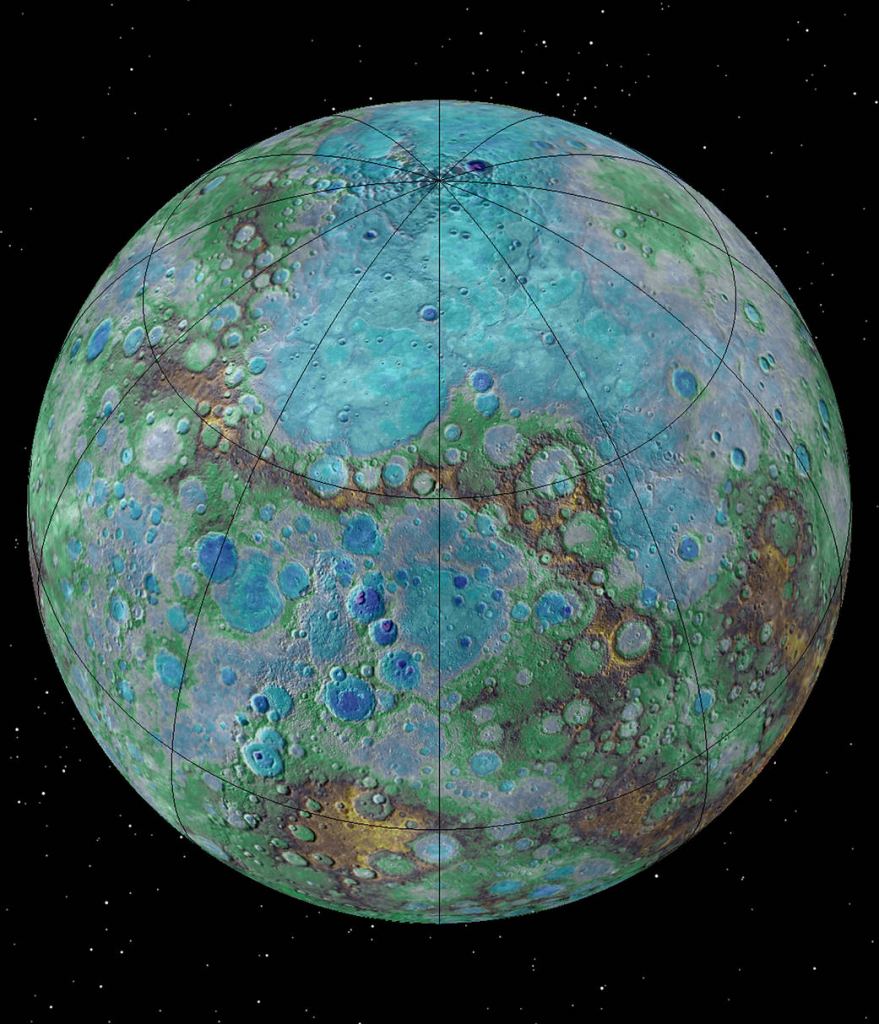 A composite image of Mercury from MESSENGER. MESSENGER showed that Mercury is tectonically active and may be shrinking. Image Credit: NASA/JHUAPL/Carnegie Institution of Washington/USGS/Arizona State University
Mercury's interior shrank as it cooled, causing its outermost rocky layers to crumble and form scarps, ridges, and other tectonic features. Uniform shrinking could make shortening structures (the wrinkled features on the surface) common all across the surface. But craters caused by billions of years of impacts have left Mercury's surface riddled with depressions and debris that make it more difficult to identify the signs of contraction.
This was the theory Gaku Nishiyama, a planetary scientist at the German Aerospace Center (DLR) Institute of Space Research, and his team sought to investigate. He and his colleagues combined previous geological maps that showed contraction features with new maps of Mercury's surface roughness. The combined data showed, for the first time, that the roughest areas on Mercury had fewer visible surface wrinkles, suggesting that impact debris could be covering them up.
They then estimated how much contraction occurred planet-wide (including under rough patches) based on the amount required to form ridges and scarps in smoother areas. This revealed that missing features in rough areas could indicate a rate of shrinkage up to 10% to 30% more than previously thought. That means that over the planet's lifetime, its diameter has been shrinking by around 7.5 km to 23 km (4.75 to 14.5 mi), rather than the current estimate of 4 to 16 km (2.5 to 10 mi).
These findings naturally have implications for what scientists can infer about Mercury's interior structure. Based on the available data, scientists already believed that Mercury has a metallic core that makes up a much larger share of its diameter and mass than the other rocky planets. But as Nishiyama explained in an AGU news article, these new findings suggest it could be larger and more complex:
More shrinking means Mercury could have a larger metal core, less light elements like silicon mixed into the metal core, or a higher starting temperature. [A difference of] 30% is a little bit surprising, but the corrected amount of contraction actually makes sense to me.
 BepiColombo images Mercury during its 2022 flyby. Credit: ESA/BepiColombo/MTM
In essence, these updated estimates on how much Mercury has cooled and shrunk during its history are more consistent with predictions based on physical models. This suggests that we are closer to understanding Mercury's structure, composition, and geodynamic evolution. However, Nishiyama and his team emphasize that the updated figures could be an underestimate, since the latest data provided by NASA's MESSENGER mission (which ended in 2015) can only measure features larger than ~5 km (3 mi) in diameter.
This will change by November 21st, 2026, when the ESA's BepiColombo arrives around Mercury and begins making higher-resolution scans of the planet's surface. As a member of the mission science team, Nishiyama and his colleagues hope this new data will reveal contraction features in greater detail than ever. The results will not only tell us more about Mercury's history, but also inform our understanding of how rocky planets orbiting closely to their parent stars evolve.
Further Reading: AGU
